Dear SSAR Community,
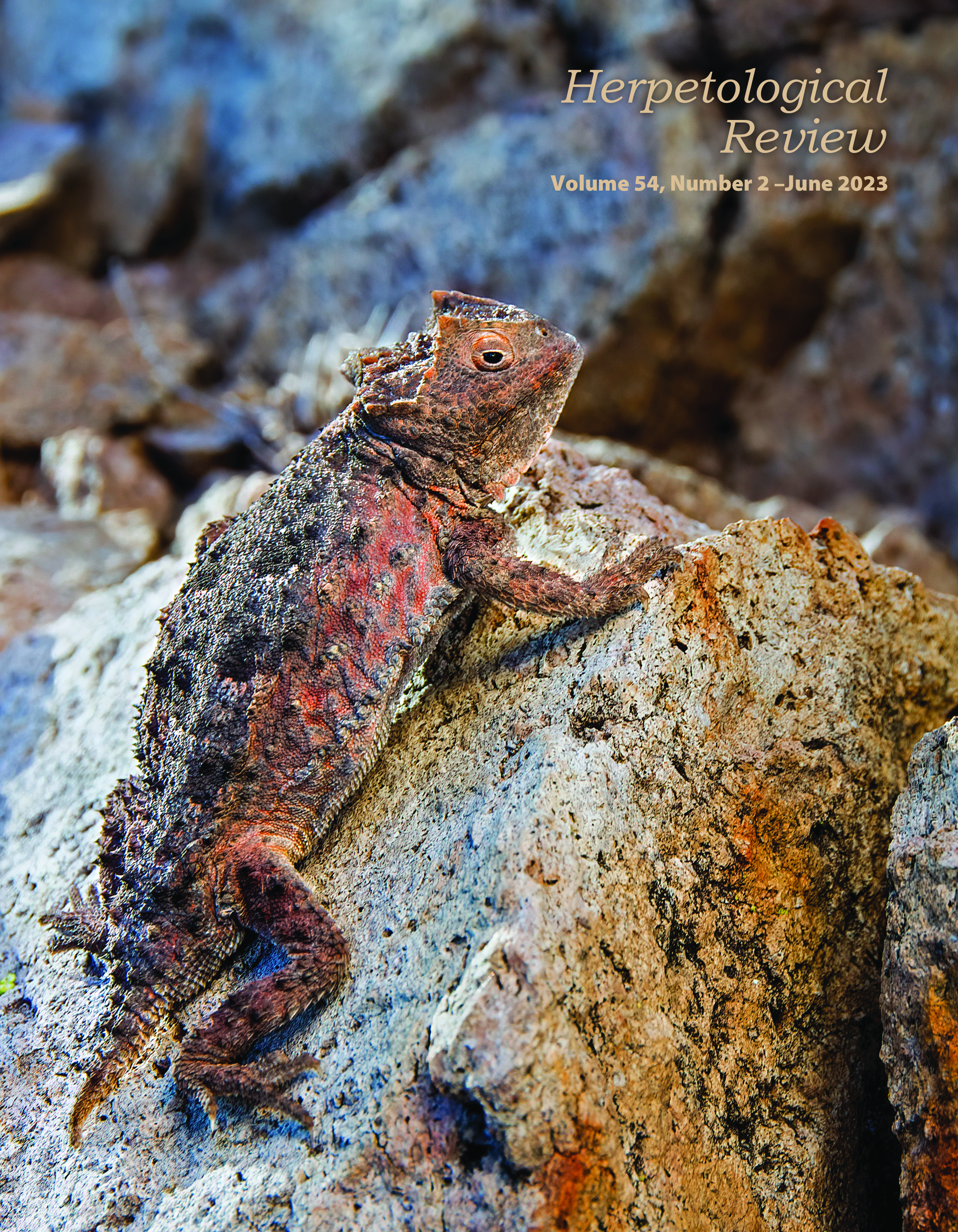
Did you receive a copy of the June issue of Herpetological Review?
Please see this message from Allen Press:
Allen Press Client Services
Research, Conservation, Education
Posted by SSAR
Posted by SSAR
We are excited to present the list of talks along with information on speakers! For a full program including abstracts, please see the JMIH 2022 website: https://burkclients.com/JMIH/meetings/2022/program/index.php
This symposium is sponsored and financially supported by the Society for the Study of Amphibians and Reptiles (SSAR), with additional sponsorship by the American Society of Ichthyologists and Herpetologists (ASIH) and the Herpetologists’ League (HL). Come, listen, and learn from past recipients of the Meritorious Teaching Award in Herpetology (MTAH) in the morning, then join one of our afternoon workshops to help us build a best practices instructional tool kit!
Symposium co-organizers: Theodora Pinou & Brad Shaffer
Introduction to the Symposium
Theodora Pinou, Past Chair of MTAH Committee
Research While Teaching: Implementing a Course-based Undergraduate Research Experience (CURE) in the Herpetology Classroom.
Emily Taylor | Professor of Biological Sciences, California Polytechnic State University, MTAH ‘16
Student Centered, Active Learning Models in Herpetology
John Maerz | Carey Distinguished Professor of Natural Resources, University of Georgia, MTAH ‘17
https://www.maerzlab.com/john-maerz-bio
The Importance of Community Building Around the Use of Natural History Collections in Education
Randy Singer | Collection Manager, Division of Fishes, Assistant Research Scientist, LSA Museum of Zoology, University of Michigan
https://randchovy.wixsite.com/randalsinger
Using Long-term Herpetological Data Sets in the Undergraduate, Graduate, and Public Education Classroom
Fredric Janzen | Professor, Kellogg Biological Station, Michigan State University, MTAH ‘18
https://www.kbs.msu.edu/research/labs/janzen/
Building a Better Herpetology Course that (Hopefully) Works for Everyone
Brad Shaffer | Distinguished Professor, UCLA, MTAH ‘15
https://sites.lifesci.ucla.edu/eeb-shafferlab/; https://www.ioes.ucla.edu/lakretz/; https://www.ccgproject.org/
Using Scientific Specimens and Their Digital Surrogates in Teaching Herpetology
David Blackburn | Curator of Herpetology, Florida Museum of Natural History, University of Florida
https://www.floridamuseum.ufl.edu/blackburn-lab/
Authentic Research Experience: Integrating Real Data and Student-led Experimental Design in Herpetology Courses
Alison Davis Rabosky | Assistant Professor in ecology and Evolutionary Biology, Assistant Curator, Museum of Zoology, University of Michigan, MTAH ‘21
http://www-personal.umich.edu/~ardr/index.html
Going Live: The Benefits and Challenges of Incorporating Live Animals in Herpetology Courses
Robert E. Espinoza | Professor of Biology and Curator of Amphibians and Reptiles, California State University
Self – Directed Learning in the Herpetology Classroom
Theodora Pinou | Professor of Biology, H.G. Dowling Herpetological Collection Faculty Curator, Western Connecticut State University
https://sites.wcsu.edu/pinout/; https://www.wcsu.edu/biology/surf/faculty-mentors/pinou/
Concluding Remarks and Preparing for the Afternoon Workshop
Brad Shaffer, Past Chair of MTAH Committee
1. Multi-campus Projects
Facilitators: Brad Shaffer, Fredric Janzen, Robert Espinoza
2. Comparative Phylogenetics/Biogeography
Facilitators: Alison Davis Rabosky, Randy Singer, David Blackburn
3. Flipped Classrooms & Active Learning Wildcard
Facilitators: John Maerz, Emily Taylor, Theodora Pinou
Workshop Summary and Dissemination
co-organizers
Posted by SSAR
We are excited to present the list of talks along with information on speakers. For a full program including abstracts, please see the JMIH 2022 website: https://burkclients.com/JMIH/meetings/2022/program/index.php
This symposium is sponsored by the Society for the Study of Amphibians and Reptiles (SSAR).
Symposium co-organizers: R. Bruce Bury and Chris R. Feldman
Introduction: Biogeography and Diversification of the Pacific Northwest Herpetofauna
Bruce Bury, Herpetological Conservation and Biology; clemmys@gmail.com
200 Million Years of Violence: How Geologic Upheaval and Glaciation Shaped the Pacific Northwest
Nicholas Geist, Sonoma State University; nick.geist@sonoma.edu
Phylogeography of Endemic Stream Amphibians in the Pacific Northwest Reveal Distinct Species or Clades in Need of Conservation Attention
Karen Kiemnec-Tyburczy, Cal Poly Humboldt; kmk877@humboldt.edu
Variation in the mouth parts of the Coastal Tailed Frog (Ascaphus truei)
Mark Leppin, Oregon State University; leppinm@oregonstate.edu
Amphibian Occupancy Modeling of an Inland Northwest Farmed Ecosystem: A Surprising Predictor of Occupancy
Erim Gomez, University of Montana erimgomez@gmail.com
Fraying edges and holes in the fabric: How range disintegration influences genetic structuring in the California red-legged frog Rana draytonii
Jonathan Richmond, U.S. Geological Survey; jrichmond@usgs.gov
Plethodontid Salamander Species Formation and Lineage Boundaries within California’s North Coast Ranges and the Klamath Mountains
Sean Reilly, University of California; sreilly@ucsc.edu
Aridification and the Diversification of Slender Salamanders (genus Batrachoseps) in Western North America
Elizabeth Jockusch, University of Connecticut; elizabeth.jockusch@uconn.edu
Against “Speciation”: David Wake on Species and the Biogeography of the Salamander Ring Species Ensatina eschscholtzii
Shawn Kuchta, Ohio University; kuchta@ohio.edu
Morphological Species Delimitation of the Cryptic Northern and Southern Pacific Pond Turtles (Actinemys marmorata, Actinemys pallida)
Robert Burroughs, Seattle Children’s Research Institute; robert.w.burroughs@gmail.com
Exploring phenotype divergence among incipient species: A case study from the Southern Alligator Lizard species complex (Elgaria multicarinata spp)
Rory Telemeco, California State University Fresno; telemeco@mail.fresnostate.edu
Biogeography and Diversification of Western Fence Lizards at their Northern Extreme in the Pacific Northwest.
Hayden Davis, University of Washington; hrdavis1@uw.edu
Genomic data reveal local endemism in Southern California Rubber Boas and the critical need for enhanced conservation actions
Jesse Grismer, La Sierra University; jgrismer@lasierra.edu
Colonization history and lineage diversification for three lizard taxa inhabiting the California Channel Islands
Lauren Chan, Pacific University; chan5416@pacificu.edu
Genetics versus genomics and what each tells us about western US reptile and amphibian phylogeography
Brad Shaffer, UCLA; Erin Toffelmier, UCLA; brad.shaffer@ucla.edu
The Melting Pot, interpreting the origin of the admixed herpetofauna of coastal southern California
Robert Fisher, USGS; rfisher@usgs.gov
Landscape patterns of adaptive and neutral variation match between predator (Thamnophis couchii) and prey (Taricha sierrae) in the Sierra Nevada
Chris Feldman, University of Nevada, Reno; ophis@unr.edu
Historical isolation and connectivity influence coevolutionary patterns of toxin resistance in the aquatic garter snake (Thamnophis atratus)
Chris Feldman, University of Nevada, Reno; ophis@unr.edu
Genomic Approaches to Detecting Signals of Local Adaptation with Application using Western Herpetofauna
Tereza Jezkova, Miami University; jezkovt@miamioh.edu
Applying genetics to inform the three R’s (resiliency, redundancy, and representation) for conservation of California’s rich diversity of herpetofauna
Amy Vandergast, USGS Western Ecological Research Center; avandergast@usgs.gov
Conservation of Endemic Old-Growth Forest-Associated Amphibians in the US Northwest
Deanna Olson, USDA Forest Service, Pacific Northwest Research Station deanna.olson@usda.gov
Projected threats of climate change to stream amphibians of the Pacific Northwest
Gwen Bury, US Forest Service gwen.bury@gmail.com
Predicting Future Hotspots of Squamate Diversity in the Pacific Northwest as the Climate Changes
David S Pilliod, U.S. Geological Survey, Forest and Rangeland Ecosystem Science Center; dpilliod@usgs.gov
Posted by SSAR
We are excited to present the list of talks along with information on speakers! For a full program including abstracts, please see the JMIH 2022 website:
https://burkclients.com/JMIH/meetings/2022/program/index.php
This symposium is sponsored by the American Society of Ichthyologists and Herpetologists (ASIH), Herpetologists’ League (HL) and the Society for the Study of Amphibians and Reptiles (SSAR), with additional support from the National Science Foundation (award #2016872, $46,586) for several supplemental events and programs, including:
Symposium co-organizers:
Itzue Caviedes-Solis, Jennifer Deitloff, Robert Denton, Lori Neuman-Lee, and Jessica Tingle
Introduction to the symposium
Symposium organizers
Finding the great balance: Family and science
Lorin Neuman-Lee | Assistant Professor, Arkansas State University
http://neumanleelab.weebly.com/ | @CheloniaGirl
How can higher education live up to our diversity, equity, and inclusion goals?
Jennifer Deitloff | Associate Professor, Lock Haven University
https://lockhaven.edu/biologydep/faculty/JenniferDeitloff.html | @SalamanderJenn
An ecological approach to disabilities in science
Krista Koeller | Unaffiliated Researcher
https://kkoeller3115.wixsite.com/kristakoeller | @KristaLerista
Zoos, herpetology, and the scientific community: An international perspective
Sinlan Poo, | Senior Research Scientist, Memphis Zoo
sheilapoo.com | @SinlanPoo
Code-switching: Countering identity-based discrimination in fieldwork
Brittany McCall | PhD Candidate, Arkansas State University
www.brittanylatricemccall.weebly.com | @McCallMeB
#FINDTHATLIZARD: Ecology, science outreach, and supporting underrepresented groups in herpetology and natural resources
Earyn McGee | Unaffiliated Researcher
https://earynmcgee.com/
Turtle camp research and education in ecology program
Fredric Janzen | Professor, Kellogg Biological Station, Michigan State University
https://www.kbs.msu.edu/research/labs/janzen/
Promoting positive experiences in nature through bird education
Jeramie Strickland | Manager of Education and Community Outreach, Openlands
https://openlands.org/about/staff/jeramie-strickland/
Natural history museums as incubators for student engagement and diversifying skills
Michelle Koo | Biodiversity Informatics and GIS Staff Curator, Museum of Vertebrate Zoology, University of California Berkeley
https://mkoo.github.io/ | @koomapper
Spheres of influence: Being a queer mentor, advocate, and activator in biology and higher education
M. Rockwell Parker | Associate Professor, James Madison University
https://www.jmu.edu/biology/people/current-people/faculty/faculty-parker.shtml | https://www.jmu.edu/biology/ridge/about.shtml
“It’s completely erasure”: A qualitative exploration of experiences of transgender, nonbinary, gender nonconforming, and questioning students in biology courses
Sarah Eddy | Assistant Professor, Florida International University
https://myweb.fiu.edu/seddy/
Global Women in Herpetology Project
Umilaela Arifin | Marie Curie Research Fellow, Leibniz Institute for the Analysis of Biodiversity Change & the Museum of Vertebrate Zoology, University of California Berkeley
https://umilaelaarifin.wixsite.com/homepage | https://de.linkedin.com/in/umilaela-arifin-23138244
Stereotype threat as a barrier to belonging, and what we can do about it
Jessica Tingle | Postdoctoral Researcher, University of Akron
Scientific interests: Evolution, biomechanics, limbless locomotion
jleetingle.com
Concluding remarks
Itzue W. Caviedes-Solis | Assistant Professor, Swarthmore College
https://www.itzuecs.com/
Posted by SSAR
Herpetological Review Volume 53, Number 2 (June 2022), is now available! Our cover features a stunning Blue Malaysian Coral Snake (Calliophis bivirgatus) that was photographed by Scott Trageser in Singapore. This colorful, slender elapid has a red head, tail, and underside and dark blue-to-black dorsum with two lighter blue stripes running down the body and inhabits lowland and low montane areas across southeast Asia. Calliophis bivirgatus is one of only a few species recognized to have elongated venom glands that extend up to 25% of the body length.
The issue has been posted online, is being printed, and will mail soon. Full contents are now available online to SSAR members at https://ssarherps.org/herpetological-review-pdfs/. Natural History Notes, Geographic Distribution Notes, and Book Reviews are Open Access and are available for download at the same link. If you are not a member of SSAR, please consider joining the leading international herpetological society (membership info here). Student and online-only rates are available. Follow the “Join SSAR” link on the home page. Congratulations to Scott for a great cover image!
Posted by SSAR
On May 19, 2022 Dr. Lee Grismer gave an exhilarating virtual presentation titled “Herpetology on the Fringes of the Sunda Shelf: Discovery, Adventure, and Conservation.” A video recording is now available for those who couldn’t make it (and for those who want to watch it again!)
Video: Herpetology on the Fringes of the Sunda Shelf, by Lee Grismer
Posted by SSAR
The form populates a view-only spreadsheet that prospective applicants can use to find labs that match their interests.
The spreadsheet has five separate tabs to help you navigate:
Check back periodically for new entries, which are added to the bottom of the spreadsheet.
Most PhD programs will cover your tuition and pay you a stipend; master’s programs may or may not be funded (someone put together this handy spreadsheet to provide information on some funded master’s programs in organismal biology). Funding situations vary wildly by department, though, so you should reach out to people whose labs interest you to ask for details.
Sending the first email to a prospective advisor can be intimidating. If you have a mentor who can help you, it’s wise to get their help. If you need to figure out how to write the email on your own, this blog post has some useful tips: https://contemplativemammoth.com/2013/04/08/so-you-want-to-go-to-grad-school-nail-the-inquiry-email/
You will want to choose a lab that not only does research you find interesting, but that will also provide a supportive environment where you can thrive. Many factors go into a good graduate school experience. Bobby Espinoza, a professor at Cal State Northridge, has prepared a list of sample questions that you might want to ask of prospective advisors, their current students (very important!), and other people in the department to collect the information you will need to make an informed graduate school decision: Questions for Prospective Advisors & Programs.
Posted by SSAR
In April-May 2021, SSAR’s Diversity, Equity, and Inclusion Committee (DEIC) created and disseminated a membership diversity survey with several purposes:
The DEIC has completed a thorough report on the survey results. We encourage all SSAR leaders and committees to read and think deeply about the entire report, to consider how its findings might guide their current and future activities, and then to enact positive change on the institutional level. We encourage all SSAR members to learn from these findings and to consider that they as individuals can contribute a more inclusive environment in SSAR and in all their spheres of influence.
See below for links to the full report and to a shortened version:
Posted by SSAR
Do you want to help parents make the most out of the 2022 Joint Meeting of Ichthyologists and Herpetologists (JMIH) in Spokane? SSAR, ASIH, AES, and HL have joined forces for a fundraiser for childcare.
We are accepting donations via the ASIH website – scroll to the link at the bottom that says Childcare Fund: link to donation page. Please note that you will have to make a (free) ASIH account, if you do not already have one.
Our goal for this fundraiser is to offset the costs so that we can offer subsidized childcare to our members (free to student parents!) These funds will make JMIH more accessible to members with families. Here is a video with a message from our presidents: link to YouTube video.
We also plan to support childcare into the future by establishing an endowment, so please stay tuned for long-term fundraising efforts!
Posted by SSAR
For more information on the program, see https://ssarherps.org/ssar-awards/grants-in-herpetology/.
Conservation:
Travis Rainey (Central Michigan University), “A Tiny Frog Facing Big Problems: Assessing Population Structure and Landscape Genetics at the Range Edge of a Declining Species.”
Iwo Gross (Auburn University), “Evaluating the Conservation Priority of Diamond-Backed Terrapin (Malaclemys terrapin) Nesting Beaches along the Northern Gulf of Mexico.”
International:
Avantika Deep Sharma (National Centre for Biological Sciences, Bangalore, India), “Intra-sexual interactions, signaling and spacing in the gliding lizard Draco dussumieri.”
Yashendu C Joshi (National Centre for Biological Sciences, Bangalore, India), “The Crocodile Conundrum of Charotar: Understanding Crocodile Behaviour and their Socioecological Connections with Humans.”
Remo Boscarino-Gaetano (University of Guelph, Canada), “Population genetics of fragmented and non-Fragmented Populations of a Reptile at its Northern Range Limit.”
Travel:
Alondra Medina (James Madison University), “Does Soil Stoichiometry Affect Leaf Litter Amphibian and Reptile Abundance, Biomass and Community Structure in Neotropical Wet Forests?”
Kathleen Webster (University of New Mexico), “Assessing the Vulnerability of Island Endemic Herpetofauna to Environmental Change in the Comoros Archipelago.”
Morgan R. Muell (Auburn University), “Examining Geographic Variation in Developmental Plasticity in Anolis carolinensis.”
Laboratory research:
Teslin Chaney (The University of Texas El Paso), “Phylogenetics and Integrative Taxonomy of African Water Snakes (Squamata: Colubridae: Grayia).”
Anna Bushong (Purdue University), “Using an Amphibian Model to Study the Effects of Forever Chemicals.”
Grace Vaziri (University of Connecticut), “Experimentally Testing how Past and Current Winter Conditions Shape pre-Hibernation and Immune Phenotypes in Wood Frogs.”
Rysa Thomas (James Madison University), “Characterization of Glucocorticoid and Mineralocorticoid Receptor Expression across a Seasonal Life-History Transition in the Red-Sided Garter Snake, Thamnophis sirtalis parietalis.”
Undergraduate research:
Scott Kornfeind (Moravian University), “Understanding the Effects of Microplastics on Anuran Larval Development.”
Yucheol Shin (Kangwon National University, Korea), “Integrative Approaches to Resolve the Species Boundary between Elaphe anomala and Elaphe schrenckii (Serpentes: Colubridae): One Variable Species or Two Distinct Species?”
Field Research in Herpetology:
Savannah Weaver (California Polytechnic State University), “Assessing the Variability of Evaporative Water Loss and Hydration Across Species, Time, and Space.”
Brendan Enochs (University of Connecticut), “The Role of Forest Floor Microclimate Variation in the Maintenance of the Plethodon cinereus Color Polymorphism.”
Kentrell Richardson (James Madison University), “Understanding Context-Dependent Responses to Climate Change in Arizona Tiger Salamanders (Ambystoma mavortium nebulosum).”
Sarah Sexton (Southeastern Louisiana University), “Estimating the Sex Ratio of Hatchling Hawksbill Sea Turtles in Bocas del Toro, Panama.”
Education:
Mahamad Sayab (Tribhuvan University, Nepal), “Conservation of Snakes through Community Outreach Programs and School Teaching.”
Ashley Taylor (Zoo Atlanta), “Snakes of Metro Atlanta Identification Guide.”
Chair of the Roger Conant Grants-In-Herpetology, Roberto Brenes, would like to sincerely thank the SSAR-Roger Conant GIH Reviewers who all worked very hard. He greatly appreciates their time and effort.
Donald Brown (West Virginia University)
Grover Brown (Jacksonville State University)
Daniel Edwards (University of California, Merced)
Eric Gangloff (Ohio Wesleyan University)
Chris Gienger (Austin Peay State University)
Letecia Ochoa (UNAM, Mexico)
Beth Reinke (Northeastern Illinois University)
Dean Williams (Texas Christian University)